
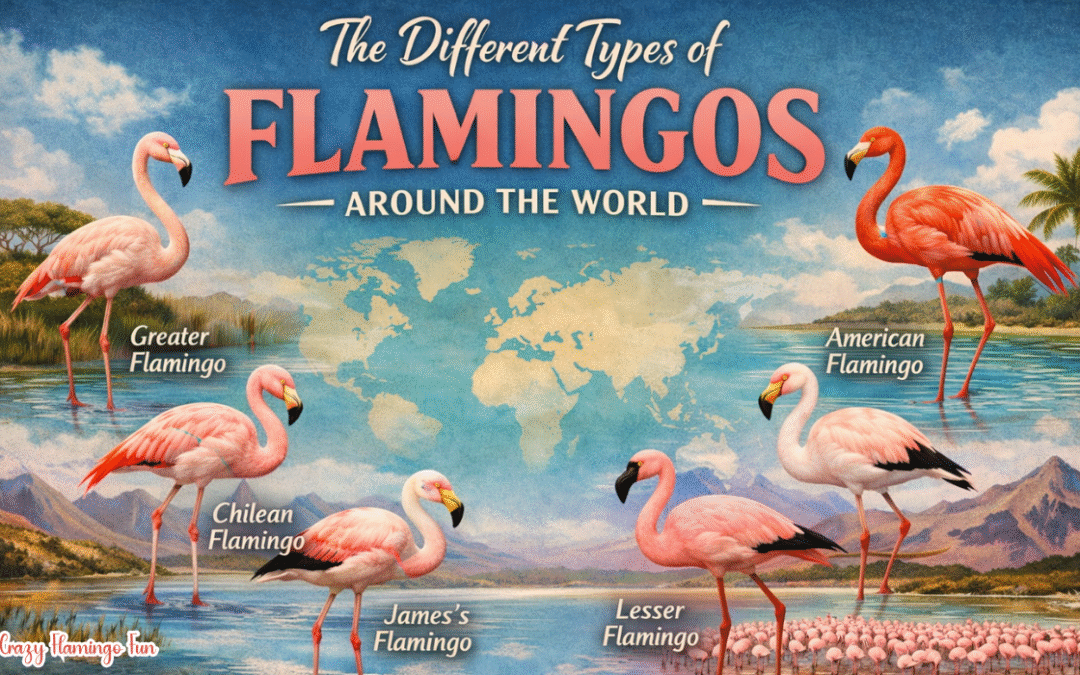
Discover the Six Unique Species !
Flamingos are some of the most recognizable birds on the planet. With their long legs, curved necks, and unmistakable pink coloring, they feel almost unreal—like something out of a tropical dream. But what many people don’t realize is that flamingos aren’t just one kind of bird.
There are six different species of flamingos found across the world, each with its own range, coloring, and quirks. From the Caribbean to the Andes Mountains, these elegant birds have adapted to some of the harshest environments on Earth.
Let’s take a trip around the globe and meet all six types of flamingos.
1. Greater Flamingo (Phoenicopterus roseus)

The largest and most widespread flamingo species
The Greater Flamingo is what most people picture when they think of flamingos. It’s the tallest of all flamingo species, standing up to 5 feet tall, and it has a pale pink body with darker pink wing feathers and black flight feathers.
Where they live:
Southern Europe, Africa, The Middle East, South Asia

Greater Flamingos are incredibly adaptable and can be found in coastal lagoons, salt pans, and large lakes. They often live in massive colonies that can number in the tens of thousands.
Fun fact:
Greater Flamingos can live 40–60 years, making them one of the longest-living bird species in the wild.
2. American Flamingo (Phoenicopterus ruber)

The brightest pink flamingo of them all
If you’ve ever seen flamingos in Florida, the Caribbean, or the Bahamas, you’ve met the American Flamingo. This species is known for its deep coral-pink to reddish coloring, making it the most vibrantly colored flamingo in the world.
Where they live:
Florida, Caribbean islands, Mexico, Central America, Northern South America

Their intense color comes from a diet rich in shrimp and algae loaded with carotenoids.
Fun fact:
Wild American Flamingos disappeared from Florida for decades but have made a slow and exciting comeback in recent years.
3. Chilean Flamingo (Phoenicopterus chilensis)

A softer pink beauty of South America
The Chilean Flamingo has a more subtle pink coloring compared to the American Flamingo, often appearing pale pink with grayish legs and distinctive pink “knees.”
Where they live:
Chile, Argentina, Bolivia, Peru

They prefer shallow lakes, lagoons, and salt flats, often sharing habitats with other flamingo species.
Fun fact:
Their legs are grayish with pink joints—an easy way to tell them apart from other flamingos.
4. Andean Flamingo (Phoenicoparrus andinus)

One of the rarest flamingos on Earth
The Andean Flamingo lives high in the Andes Mountains, often at elevations over 13,000 feet. It has pale pink plumage with bold black wings and yellow legs.
Where they live:
High-altitude regions of Bolivia, Peru, Chile, and Argentina

This species is considered near threatened due to habitat loss and climate change affecting their fragile mountain ecosystems.
Fun fact:
Andean Flamingos are so well adapted to altitude that they thrive where oxygen levels are extremely low.
5. James’s Flamingo (Phoenicoparrus jamesi)

The flamingo once thought to be extinct
Also known as the Puna Flamingo, James’s Flamingo is smaller and more delicate-looking than other species, with pale pink feathers and a striking black bill tipped with yellow.
Where they live:
Andes Mountains of Bolivia, Chile, Argentina, and Peru

They prefer shallow lakes, lagoons, and salt flats, often sharing habitats with other flamingo species.
Fun fact:
Their legs are grayish with pink joints—an easy way to tell them apart from other flamingos.
6. Lesser Flamingo (Phoeniconaias minor)

The most numerous flamingo species
Despite their name, Lesser Flamingos are the most abundant flamingo species in the world. They are smaller than Greater Flamingos but often display intense pink coloring thanks to their algae-rich diet.
Where they live:
Eastern and Southern Africa, Parts of India

They gather in enormous flocks, sometimes numbering over a million birds, creating breathtaking pink landscapes around alkaline lakes.
Fun fact:
Lesser Flamingos can drink boiling-hot alkaline water that would burn most animals.
Why Flamingos Are Pink ?

All flamingos start life with gray or white feathers. Their famous pink color develops over time and comes entirely from their diet—specifically from carotenoid pigments found in algae, brine shrimp, and plankton.
Without these pigments, flamingos would fade back to gray.
Flamingos and Conservation

Many flamingo species face growing threats from:
Habitat loss
Climate change
Pollution
Human disturbance
Protecting wetlands and salt lakes is critical not just for flamingos, but for countless other species that depend on these fragile ecosystems.
Supporting conservation programs, wildlife refuges, and responsible eco-tourism helps ensure that flamingos remain part of our world for generations to come.
Final Thoughts
From the bold pink American Flamingo to the rare Andean and James’s Flamingos of the high mountains, these birds are far more diverse than most people realize. Each species tells a story of adaptation, survival, and beauty in some of the most extreme environments on Earth.
Whether you admire them in the wild, spot them from afar, or celebrate them through art, travel, and a few well-placed lawn flamingos, one thing is certain—flamingos are unforgettable.

“From tropical shores to mountain lakes, every flamingo has a story—and a splash of pink worth celebrating. Stay curious, stay colorful, and keep your flamingo flair shining.” 🦩
— Mingo the Flamingo